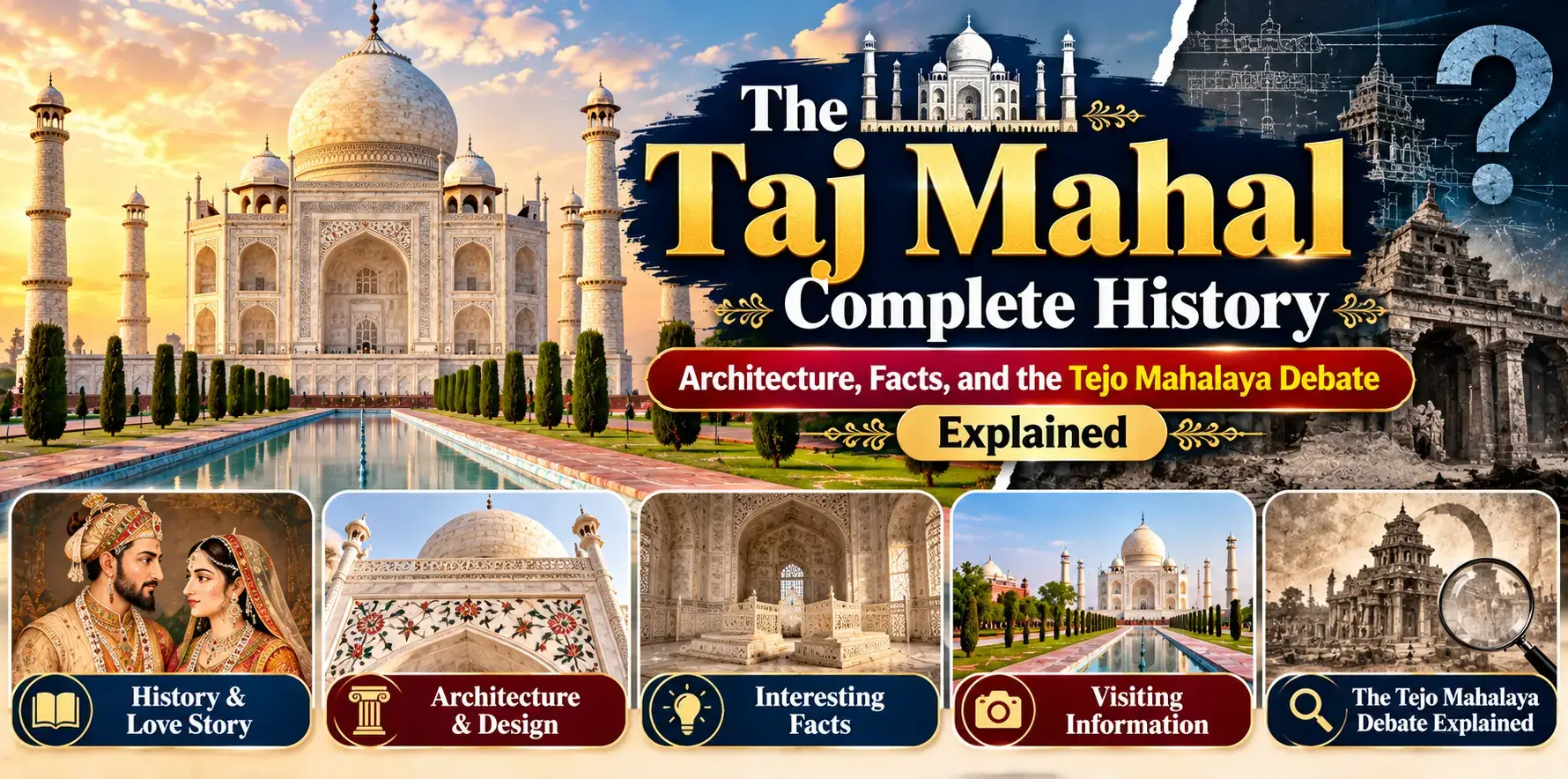
🕌 Introduction: A Love Story Written in Marble
The Taj Mahal complete history begins with love, loss and legacy. Standing on the southern bank of the Yamuna River in Agra, it is one of the world’s most admired monuments and a symbol of eternal love.
Mughal Emperor Shah Jahan built it in memory of his wife Mumtaz Mahal, who died in 1631 while giving birth to their 14th child. Work began around 1632, and the main mausoleum was finished by about 1648. The full complex of gardens, mosque and gateway took until about 1653. Historians commonly estimate that around 20,000 artisans and workers took part, and Ustad Ahmad Lahauri is traditionally named as the chief architect.
⚡ Quick answer: The Taj Mahal is a white marble mausoleum in Agra, built by Shah Jahan between about 1632 and 1653 for Mumtaz Mahal. It became a UNESCO World Heritage Site in 1983.
📌 Taj Mahal Complete History: 10 Key Facts
| # | Fact | Detail |
|---|---|---|
| 1 | Built by | Mughal Emperor Shah Jahan |
| 2 | Built for | Mumtaz Mahal, his wife, who died in 1631 |
| 3 | Construction | About 1632 to 1653 |
| 4 | Location | Agra, Uttar Pradesh, India |
| 5 | Chief architect | Ustad Ahmad Lahauri (traditionally credited) |
| 6 | Main material | White Makrana marble |
| 7 | Style | Mughal, blending Persian, Islamic and Indian elements |
| 8 | Calligraphy | Amanat Khan of Shiraz |
| 9 | Recognition | UNESCO World Heritage Site since 1983 |
| 10 | Cost | Estimated at about 32 million rupees at the time (modern equivalents are rough estimates) |
🕰️ Part 1: Taj Mahal Complete History, from Love to Legacy
The Taj Mahal complete history is tied to the artistic peak of the Mughal era. Shah Jahan ruled from 1628 to 1658, and his reign is considered the high point of Mughal architecture.
According to UNESCO, the Taj Mahal is a mausoleum complex that includes gardens, a mosque and a guest house. The design reflects the Islamic idea of paradise. Later in life, Shah Jahan was imprisoned in Agra Fort by his son Aurangzeb. He is buried beside Mumtaz Mahal.
🏛️ Part 2: Taj Mahal Architecture, a Perfect Balance of Art and Science
The Taj Mahal complete history cannot be told without its architecture. The complex follows a symmetrical plan built around the Charbagh (four-garden) layout, inspired by Persian paradise gardens.
🏗️ Key Architectural Features
- Main mausoleum: built of white Makrana marble from Rajasthan.
- Height: the structure, including the finial, rises to about 73 metres.
- Minarets: four minarets stand at the corners of the platform. They lean slightly outward, which is commonly explained as a safeguard so they would fall away from the tomb in an earthquake.
- Pietra dura: semi-precious stones such as jade, crystal, lapis lazuli and turquoise are inlaid into the marble in floral patterns.
- Calligraphy: Quranic verses in black marble were written by the calligrapher Amanat Khan of Shiraz.
🧭 Part 3: Inside the Taj Mahal, What to See
Most visitors admire the Taj Mahal from outside, but each part of the complex has its own story.
1. The Main Gateway (Darwaza-i Rauza)
Made of red sandstone and inscribed with Quranic verses. It is often interpreted as the passage from the everyday world into paradise.
2. The Charbagh Gardens
Water channels divide the gardens into four sections, which represent the rivers of paradise. The reflection of the Taj in the central pool is one of the most photographed views in the world.
3. The Mausoleum Chamber
It holds the cenotaphs of Mumtaz Mahal and Shah Jahan. The real graves lie in a lower chamber. An intricately carved marble screen surrounds the cenotaphs.
4. The Mosque and the Jawab
The mosque on the west is built of red sandstone. The “jawab” on the east mirrors it to keep the layout symmetrical. The mosque is still used for Friday prayers.
5. The Night View
On full-moon nights, the marble takes on a silvery glow. Night viewing is limited to small groups, so check the Archaeological Survey of India (ASI) for current rules and tickets.
🔍 Part 4: Myths, Legends and the Tejo Mahalaya Debate
A well-known part of the Taj Mahal complete history is the “Tejo Mahalaya” theory. Writer P.N. Oak claimed the Taj Mahal was originally a Shiva temple. Here is what the record shows:
- Courts: the Supreme Court dismissed Oak’s petition in 2000, and the Allahabad High Court dismissed a 2022 petition seeking to open the sealed rooms.
- ASI and historians: mainstream historians and the ASI treat the Taj Mahal as a Mughal monument, supported by Mughal-era records, its architecture and its inscriptions.
- Sealed rooms: the locked basement rooms are closed for conservation and safety reasons, according to the ASI.
The documented history is that Shah Jahan built the Taj Mahal as a tomb for Mumtaz Mahal.
🔬 Part 5: Artistic and Engineering Marvels
- Changing colours: the marble looks pinkish in the morning, white at midday and golden at sunset or under moonlight.
- Acoustics: sound inside the central chamber echoes for a long time, which adds to the atmosphere.
- Foundation: the Taj stands on well foundations that use wood and rubble near the river. Conservationists watch the Yamuna’s water level because a dry riverbed could threaten the structure.
- Symmetry: nearly every element has a mirror on the other side, except the two graves inside.
🎟️ Part 6: Visitor Guide, How to Experience the Taj Mahal
⏰ Best Time to Visit
- Sunrise: soft light and smaller crowds.
- Full-moon nights: a special view, with limited tickets.
- Fridays: the Taj Mahal is closed to tourists because of prayers.
- Season: October to March has the most comfortable weather.
🚪 Entry Gates
The Taj Mahal has East, West and South gates. The East Gate is usually less crowded, and the West Gate is often the busiest. Gate rules and ticket counters can change, so confirm them before you go.
📸 Photography Tips
- Capture the reflection from the central pool.
- Visit Mehtab Bagh across the river for sunset views.
- Arrive early for fewer people in your frame.
🗺️ Nearby Attractions
- Agra Fort: about 2.5 km away
- Itimad-ud-Daulah’s Tomb (“Baby Taj”): across the river
- Fatehpur Sikri: about 40 km away
🌿 Part 7: Taj Mahal Today, Preservation and Future
The Taj Mahal complete history continues in modern times. Air pollution has yellowed parts of the marble, so protecting it is an ongoing job.
- Taj Trapezium Zone (TTZ): a protected area of about 10,400 sq km where polluting industries are restricted.
- Mud-pack cleaning: conservators use Multani mitti (fuller’s earth) clay packs to lift stains from the marble.
- Cleaner transport: petrol and diesel vehicles are kept away from the monument, and battery-powered vehicles are used near it.
💫 Part 8: Why the Taj Mahal Inspires the World
The Taj Mahal complete history is the story of devotion and artistry. Poet Rabindranath Tagore described it as “a teardrop on the cheek of time.”
❓ FAQs About the Taj Mahal Complete History
Q1. Who built the Taj Mahal and why?
Shah Jahan built it in memory of his wife Mumtaz Mahal, who died in 1631.
Q2. How long did it take to build the Taj Mahal?
About 22 years, from around 1632 to 1653.
Q3. Was the Taj Mahal ever a temple?
No. The Tejo Mahalaya claim has been rejected by courts, and historians and the ASI treat the Taj Mahal as a Mughal tomb.
Q4. When is the Taj Mahal closed?
It is closed to tourists on Fridays. Always check ASI for current timings and tickets.
Q5. What is the best time to visit?
Sunrise, between October and March, gives soft light, good weather and smaller crowds.
📚 Sources and Further Reading
- UNESCO World Heritage Centre: Taj Mahal
- Encyclopedia Britannica: Taj Mahal
- Archaeological Survey of India
🏁 Final Thoughts
The Taj Mahal complete history is more than dates and stones. It is a story of love, art and cultural exchange. When you visit, walk slowly through the gardens, read the inscriptions and take in the marble in changing light.
📖 Continue Reading on My Daily Viral
- 🎬 Battle of Galwan Movie 2026 – Salman Khan’s powerful war drama
- 📱 iPhone 17 Series 2025 Review – Full review and price in India
⚠️ Disclaimer
The information in this article about the Taj Mahal’s history, architecture and legends is compiled from publicly available sources such as UNESCO, Encyclopedia Britannica and the Archaeological Survey of India (ASI), and is shared for general informational and educational purposes only. Historical details, dates and figures can vary between sources.
Visitor details such as ticket prices, opening days, timings, entry gates and night-viewing rules change from time to time. Please confirm the latest information on the official ASI website or at the ticket counters before you plan your visit.
The Tejo Mahalaya debate is covered here as a matter of public record, including court rulings. Views quoted in this article belong to the people cited and do not represent the opinion of My Daily Viral. Images used are for illustration only. My Daily Viral is not affiliated with the ASI, UNESCO or any government body and is not responsible for any loss or inconvenience arising from the use of this information.