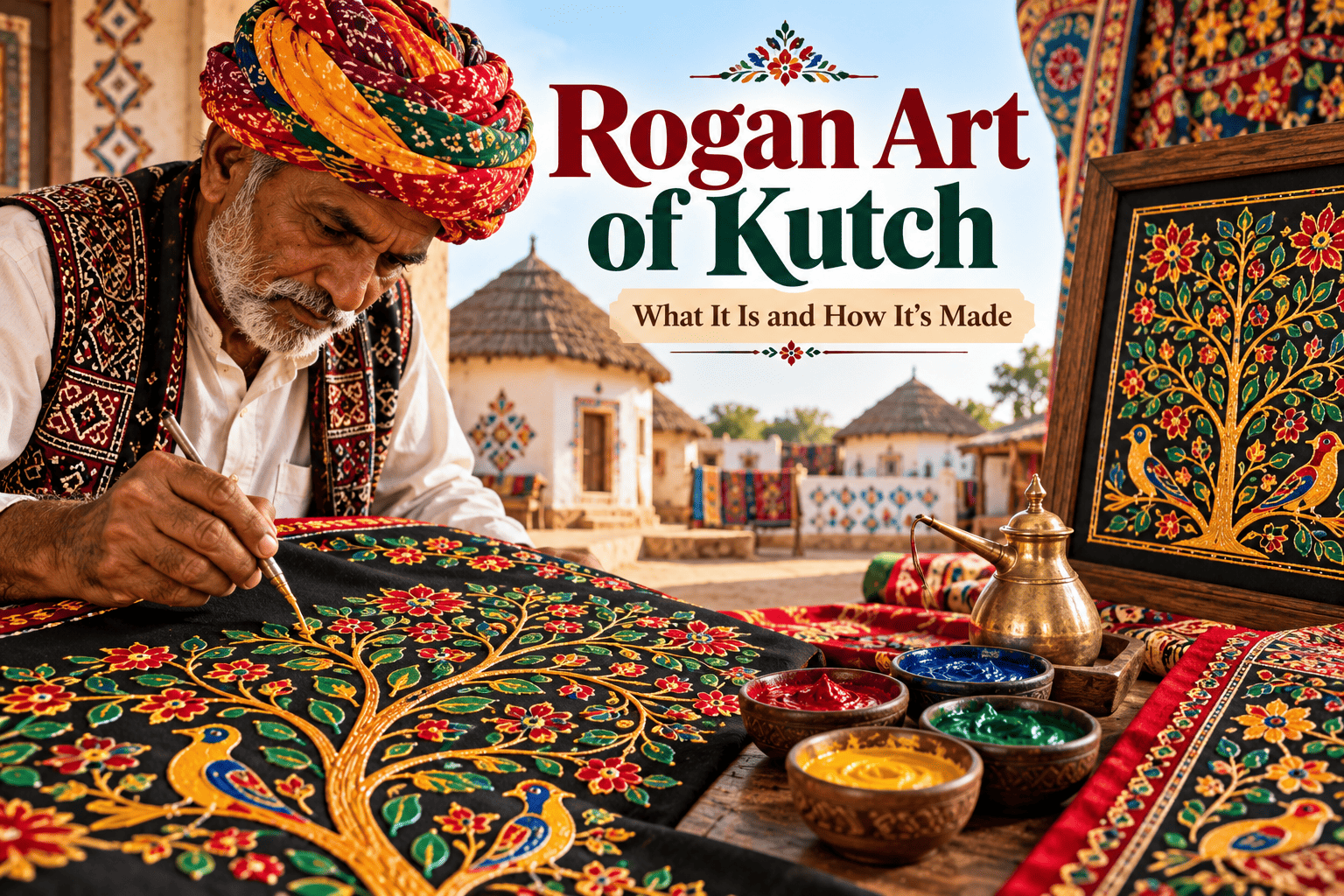
Rogan Art of Kutch: What It Is and How It’s Made
Kutch, Gujarat, is home to some of India’s most remarkable traditional crafts. Among them is Rogan art, a rare form of textile painting known for its colourful patterns, fine lines, and distinctive raised appearance. Unlike ordinary painting, this technique uses a thick, oil-based colour paste that artisans shape into delicate designs with a small metal stylus.
Practised in Nirona village, this remarkable craft reflects generations of artistic knowledge and patience. From floral patterns to the famous Tree of Life design, every piece showcases the skill required to transform simple fabric into decorative artwork.
In this guide, discover the history of Rogan painting, how artisans make it, the traditional designs they create, and where you can see or buy authentic Kutch handicrafts.
The beauty of Rogan Art of Kutch comes from its unique oil-based colours and the artisan’s ability to create fine patterns by hand.
What Is Rogan Art?
Rogan art is a traditional form of textile painting practised in the Kutch region of Gujarat. Artisans prepare a thick, coloured paste from boiled oil and pigments, then use a pointed metal tool to draw intricate patterns onto fabric.
The word Rogan comes from Persian and refers to oil or an oil-based substance. The technique is different from conventional painting because the artisan draws out the sticky colour into fine threads and places them carefully on the cloth.
Traditional designs include flowers, leaves, birds, geometric patterns, and decorative compositions. The finished work often has a slightly raised, glossy appearance that makes the motifs stand out against the fabric.
The beauty of Rogan Art of Kutch lies in the way artisans transform thick, oil-based colours into delicate floral and geometric patterns.
The distinctive appearance of Rogan Art of Kutch comes from its thick, colourful paste, which artisans carefully shape into delicate lines and decorative motifs.
History of Rogan Painting in Kutch
A craft with Persian connections
The origins of this art are commonly traced to Persia, from where the technique is believed to have travelled to western India. Over time, it became established in Gujarat and eventually developed a strong association with Nirona, a village in Kutch.
The craft was traditionally used to decorate garments and household textiles. Rogan-painted fabrics could be found on skirts, odhanis, and other textiles associated with weddings and special occasions.
Nirona and the Khatri artisan family
Nirona is particularly known for preserving this rare tradition. The Khatri artisan family has played an important role in passing its specialised knowledge from one generation to the next.
For many years, the technique was closely guarded and taught within the family. Today, the craft continues to attract visitors, collectors, and textile enthusiasts who want to understand its unusual painting process.
The tradition is also adapting to contemporary demand through decorative panels, wall hangings, bags, and other products. <Cite refs={[“turn749692search2″,”turn749692search4″,”turn749692search22”]}/>
Understanding Rogan Art of Kutch becomes easier when you see how artisans prepare the coloured paste and use a metal stylus to create intricate designs.
How Is Rogan Art Made?
Creating a finished piece requires careful preparation, a steady hand, and detailed knowledge of the oil-based colour paste. The main stages are explained below.
Step 1: Preparing the oil-based paste
Artisans heat castor oil for several hours until it thickens into a sticky, elastic substance. The oil is carefully processed and cooled to achieve a consistency suitable for drawing fine lines.
The preparation time depends on the conditions and the technique used by the artisan.
Step 2: Adding colours
The prepared material is mixed with pigments to produce colours such as red, yellow, green, blue, and white. The exact palette depends on the design and the materials used.
The paste must be workable enough to stretch into thin lines without losing its shape.
Step 3: Preparing the drawing tool
The artisan uses a small metal stylus to pick up the coloured paste. With controlled hand movements, the paste is drawn into fine threads that can form leaves, petals, curves, and geometric details.
Unlike brush painting, the technique relies on manipulating the sticky material with the stylus to create flowing lines on the cloth.
Step 4: Drawing the design
The artisan works directly on the fabric, often without a fully drawn outline. The design develops through a series of carefully controlled movements.
The artist may begin with a central motif and build outward, adding decorative lines and smaller details. This stage demands considerable concentration because the paste is thick and difficult to correct once placed.
Step 5: Creating a mirrored pattern
One distinctive method involves folding the fabric while the design is still workable and pressing it carefully to transfer the pattern onto the opposite side. This creates a mirrored design.
Additional colours and details may then be applied separately to complete the composition.
Step 6: Drying and finishing
The finished textile is left to dry and set. Once ready, it can be displayed as a decorative panel or made into a suitable textile product.
The time required depends on the size, complexity, and level of detail in the design. Elaborate pieces can require extensive work. <Cite refs={[“turn749692search0″,”turn749692search10″,”turn749692search11”]}/>
The process of creating Rogan Art of Kutch begins with preparing a thick colour paste that can be shaped into delicate lines using a metal stylus.
Traditional Rogan Art of Kutch features floral motifs, geometric patterns, birds, and the famous Tree of Life design.
Every stage of Rogan Art of Kutch, from preparing the oil-based paste to drawing the final pattern, requires patience and precise hand movements.
5 Beautiful Rogan Art Designs
1. Tree of Life
The Tree of Life is one of the best-known designs associated with this craft. It features a central tree with branching stems, leaves, flowers, and decorative details.
The composition symbolises growth and interconnectedness in many artistic traditions. Its intricate arrangement makes it especially popular for wall hangings and framed textile artwork.
2. Floral patterns
Flowers, leaves, and curling vines are common decorative elements. Artisans use fine lines and colourful details to create patterns that look delicate from a distance and intricate up close.
3. Geometric designs
Geometric motifs use repeated lines, shapes, and balanced arrangements. These patterns demonstrate the artisan’s precision and create a striking contrast against dark fabric.
4. Birds and animals
Birds and animal-inspired motifs add movement and character to the artwork. Depending on the design, they may appear as central figures or as part of a larger decorative composition.
5. Symmetrical patterns
Symmetry is an important visual feature in many pieces. By folding and pressing the fabric during the process, an artisan can create matching halves that give the final design a balanced appearance.
What Materials Are Used?
The materials used in traditional production are relatively simple, but the technique requires specialised knowledge.
- Castor oil: Commonly used to prepare the thick, sticky painting medium.
- Pigments: Added to create different colours.
- Fabric: Traditionally, cotton or silk may be used depending on the intended product.
- Metal stylus: Used to lift, stretch, and guide the paste into fine lines.
- Preparation vessels and tools: Used to heat, cool, and mix the oil-based material.
The quality and consistency of the paste are particularly important. If it is too runny or too stiff, it becomes difficult to produce the delicate lines that define the craft. <Cite refs={[“turn749692search0″,”turn749692search6”]}/>
Nirona village is an important destination for anyone interested in Rogan Art of Kutch and the traditional skills preserved by local artisan families.
Nirona village is the best-known place to explore Rogan Art of Kutch and learn about the artisans who preserve this rare textile painting tradition.
Where Can You See Rogan Art in Gujarat?
Nirona village, Kutch
Nirona is the best-known destination for experiencing this traditional textile painting. Located approximately 40 kilometres northwest of Bhuj according to Gujarat Tourism, the village is associated with several handicraft traditions.
Visitors may be able to see artisans working, learn about the preparation of the coloured paste, and explore finished textile pieces. Availability of demonstrations and purchases can vary, so contact the workshop before travelling.
Official visitor information: Gujarat Tourism — Nirona
Bhuj and nearby craft centres
Bhuj can serve as a base for exploring the wider craft traditions of Kutch. Local handicraft outlets and craft organisations may offer textile paintings and other regional products.
Check the seller’s background and confirm that the item is genuinely made using the traditional technique.
Explore before buying
Watching the process in person can help you understand why the craft takes time and requires specialist skills. It also gives you an opportunity to ask the artisan about the design, materials, and care requirements.
Where to Buy Authentic Rogan Art
If you want to own a piece of this traditional craft, consider these options:
- Artisan workshops in Nirona: A direct visit can help you learn about the maker and see the work process.
- Recognised craft organisations: Look for organisations that provide clear information about the artisans and production method.
- Specialist handicraft retailers: Ask for details about the origin and materials of the artwork.
- Online craft sellers: Check product photographs, seller information, delivery terms, and return policies before placing an order.
For a significant purchase, ask who made the piece and whether it was painted using the traditional oil-based paste and metal stylus. Do not assume that every product labelled “Rogan” was made in Nirona.
When buying Rogan Art of Kutch, ask about the artisan, the production process, and the place where the artwork was created.
How to Identify Genuine Rogan Painting
Use these practical checks before purchasing:
- Ask about the technique: The seller should be able to explain how the paste is prepared and applied.
- Look closely at the lines: Traditional work often has distinctive raised details created by the thick medium.
- Inspect the composition: Check the symmetry, fine lines, and small decorative elements.
- Ask about the artisan: Learn where the piece was produced and who created it.
- Request provenance details: For valuable artwork, ask for any available documentation about its origin.
- Confirm care instructions: The correct handling depends on the fabric and the painting medium.
Photographs alone may not prove authenticity. Buying from a transparent artisan or established craft organisation is a safer approach.
Why Is Rogan Art Special?
This craft stands out because it combines an unusual painting medium with exceptional hand control. The artisan must prepare the paste correctly and guide it into fine patterns without relying on conventional brushes.
It also represents a living tradition preserved through specialist knowledge and family teaching. Supporting genuine makers helps maintain demand for the craft and gives buyers a closer connection to the people behind the artwork.
Today, traditional motifs are finding new uses in home décor, gifts, textile accessories, and contemporary design while retaining their distinctive character.
Frequently Asked Questions
1. What is Rogan art?
It is a traditional textile painting technique from Kutch, Gujarat, in which artisans use a thick, coloured oil-based paste to create detailed patterns on fabric.
2. Where is this craft practised?
Nirona village in Kutch is its best-known centre and an important place to learn about the traditional technique.
3. What does the word Rogan mean?
The word comes from Persian and refers to oil or an oil-based substance.
4. Which oil is commonly used?
Castor oil is commonly used to prepare the thick painting medium, which is then mixed with pigments.
5. What is the Tree of Life design?
It is a decorative composition featuring a tree with branching stems, leaves, and flowers. It is one of the most recognised designs associated with this art form.
6. Can I buy Rogan paintings online?
Yes, some specialist craft sellers and artisan businesses offer products online. Check the seller’s credentials, production details, and return policy before purchasing.
7. How long does it take to make a piece?
The time varies according to the size and complexity of the design. Detailed work may require many hours or longer.
8. How can I support traditional artisans?
Buy from transparent artisan-led businesses, learn about the maker, and share accurate information about the craft and its cultural background.
By learning about Rogan Art of Kutch, visitors and craft enthusiasts can appreciate the patience, creativity, and cultural heritage behind each handmade piece.
By exploring Rogan Art of Kutch, visitors can appreciate the patience, creativity, and specialist skills behind every handmade design.
The lasting appeal of Rogan Art of Kutch lies in its unusual technique, intricate designs, and the traditional skills preserved by artisans in Nirona.
Conclusion
Rogan painting is one of Kutch’s most distinctive craft traditions, combining an unusual oil-based medium with precise hand-drawn designs. Its fine lines, colourful motifs, and famous Tree of Life compositions reveal the patience and expertise required to create each piece.
Whether you visit Nirona to see the process or purchase artwork from a trusted artisan, understanding how it is made adds meaning to the finished textile. Supporting genuine makers helps preserve this remarkable part of Gujarat’s cultural heritage for future generations.
👗 Fashion & Festivals
-
💃 Navratri Lehengas Chaniya Cholis 2025 – Stunning Trends, Colors & Styling Ideas
-
🪔 Navratri 2025: 9 Days of Goddess, History, Rituals, Fashion & Fasting
https://myfashion.co.in/product-category/women-wear-ethnic-wear