Patola Saree: Story of Patan’s Famous Weave
Gujarat is home to some of India’s most remarkable textile traditions, and the Patola saree is among its most treasured creations. Famous for its vibrant colours, precise geometric patterns, and extraordinary craftsmanship, this luxurious silk textile represents centuries of weaving knowledge preserved by skilled artisan families in Patan, Gujarat.
Unlike printed sarees, a traditional Patan Patola is created using a complex technique called double ikat. Both the warp and weft threads are individually tied and dyed before weaving, allowing the design to emerge as the threads interlock on the loom.
The result is a richly patterned textile admired for its intricate details, cultural significance, and exceptional workmanship.
In this guide, explore the story of Patan Patola, how it is made, its traditional motifs, how to identify authentic craftsmanship, and where to see or purchase this famous Gujarati weave.
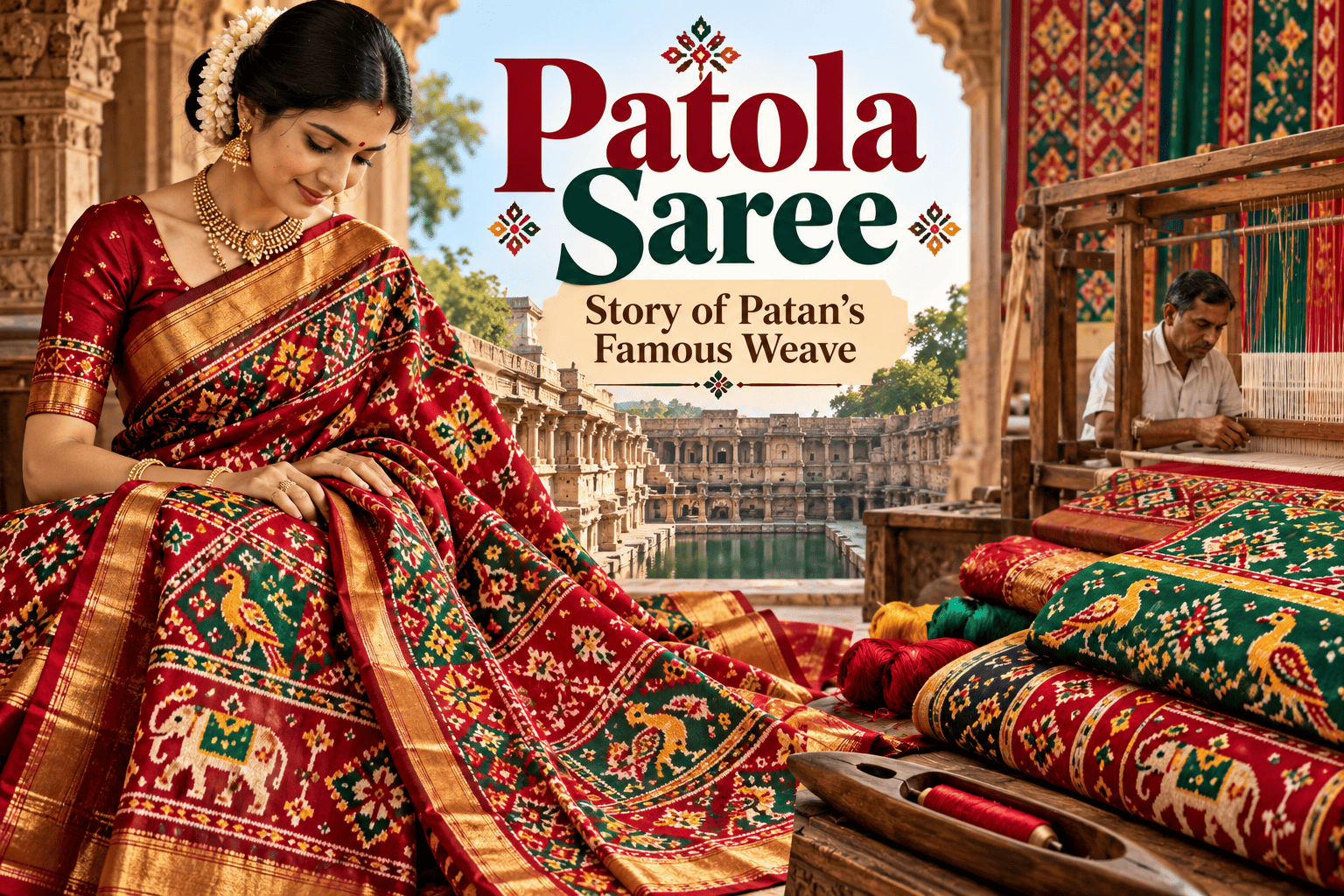
A traditional Patola saree is admired for its double ikat weaving technique, vibrant colours, and intricate patterns that reflect Gujarat’s rich textile heritage.
What Is a Patola Saree?
A Patola saree is a traditional silk textile associated particularly with Patan in northern Gujarat. Its intricate patterns are created through the precise alignment of pre-dyed threads rather than by printing a design onto finished fabric.
The traditional Patan variety uses double ikat weaving, meaning both sets of threads—the warp running lengthwise and the weft running crosswise—are resist-dyed according to the planned pattern.
When these threads are woven together, they create a detailed design that appears on both sides of the fabric. This combination of planning, dyeing, and precise weaving makes the craft exceptionally demanding.
Patan Patola has traditionally been valued for weddings, religious ceremonies, important celebrations, and heirloom collections. Today, the same weaving heritage also inspires stoles, scarves, and other textile products. <Cite refs={[“turn632788search2″,”turn632788search5″,”turn632788search10”]}/>
The History of Patan Patola
A textile tradition spanning centuries
Patan is an ancient town in northern Gujarat with a rich cultural and textile heritage. Patola weaving is widely associated with the Salvi community, whose specialised knowledge has been passed down through generations.
The precise early history is difficult to establish in every detail, but the tradition is often traced back to medieval India.
The story of King Kumarapala
One well-known historical tradition connects the establishment of Patola weaving in Patan with King Kumarapala of the Solanki dynasty, who ruled in the 12th century.
According to the commonly repeated account, the king invited skilled weavers from the Jalna region of present-day Maharashtra to settle in Patan. The story is an important part of the craft’s heritage, although details of the migration are generally presented as a historical tradition rather than a fully documented account.
The Salvi weaving community became closely associated with the preservation of this specialised textile art. <Cite refs={[“turn632788search2″,”turn632788search4″,”turn632788search24”]}/>
From royal textile to cultural heirloom
Patola was historically associated with royal and wealthy households because of the time, skill, and resources required to produce it. It also became important in certain Gujarati communities for auspicious occasions and ceremonial use.
The textile travelled beyond India as well. Patola fabrics were historically valued in parts of Southeast Asia, including Indonesia, where imported textiles influenced local traditions and ceremonial practices. <Cite refs={[“turn632788search24″,”turn632788search26”]}/>
Geographical Indication recognition
Patan Patola received Geographical Indication (GI) registration in 2013. The registration identifies the product with its recognised geographical origin and traditional production heritage.
The official record lists the Patan Double Ikat Patola Weavers Association as the applicant and records the registration under handicraft goods. <Cite refs={[“turn632788search3″,”turn632788search19”]}/>
Understanding how a Patola saree is created helps explain why this traditional silk textile requires exceptional skill, careful planning, and considerable time.
How Is a Patola Saree Made?
Creating a traditional double ikat saree involves a carefully planned sequence of design, tying, dyeing, and weaving. Each stage must match the intended pattern.
Step 1: Design planning
The artisan plans the motif and calculates how the pattern will be distributed across the warp and weft threads. This stage requires careful visualisation because the final design must align during weaving.
Step 2: Preparing the silk threads
Silk yarns are separated and arranged according to the planned design. Specific sections are tightly bound to prevent dye from reaching them.
Step 3: Dyeing the threads
The tied yarns are dyed in stages to create the required colours. Different sections may need repeated tying and dyeing to achieve a multicoloured pattern.
Step 4: Preparing both warp and weft
This is the defining stage of double ikat. Both the lengthwise and crosswise threads must be dyed in accordance with the same design plan.
Step 5: Aligning the pattern on the loom
The prepared threads are carefully positioned so the motifs meet at the correct points during weaving. Even small alignment errors can affect the clarity of the final pattern.
Step 6: Weaving the fabric
The artisan interlaces the threads on the loom. The design gradually emerges from the combination of the pre-dyed yarns, rather than being printed onto the completed cloth.
Because of the precision required, a complex saree can take several months to complete. The time depends on the design, length, thread preparation, and weaving complexity. <Cite refs={[“turn632788search1″,”turn632788search2″,”turn632788search19”]}/>
7 Traditional Patola Motifs to Know
Traditional designs often feature geometric forms, flowers, animals, birds, and symbolic objects. Some recognised motif names include the following.
1. Nari Kunjar
This traditional motif combines representations of a woman and an elephant. It is one of the distinctive figurative designs associated with Patola textiles.
2. Parrot motifs
Parrots appear in traditional Indian textile art as decorative bird figures. In Patola, they may be arranged symmetrically within the main body or other sections of the saree.
3. Elephant motifs
Elephants are a recurring design element in traditional Indian textiles. Their stylised forms add visual character and can be combined with geometric patterns.
4. Floral designs
Flowers, leaves, and plant-inspired forms are used to create decorative arrangements across the fabric.
5. Ratan Chowk
Ratan Chowk is a recognised traditional motif name associated with floral designs arranged in a geometric pattern.
6. Chhabdi
Chhabdi is associated with a basket-like motif. Its structured appearance fits naturally within the textile’s geometric design vocabulary.
7. Chokta and geometric patterns
Chokta refers to a box-like or square motif. Squares, diamonds, stripes, and other geometric elements contribute to the characteristic precision of this weave.
The names and arrangements of motifs can vary between designs and weaving traditions. <Cite refs={[“turn632788search2″,”turn632788search10″,”turn632788search11”]}/>
When choosing a Patola saree, check whether it uses double ikat or single ikat weaving, and ask the seller to explain the textile’s origin and production method.
Patan Patola vs Rajkot Patola
The name Patola is also used for other Gujarati woven textiles, so understanding the difference can help buyers choose the product they want.
| Feature | Patan Patola | Rajkot Patola |
|---|---|---|
| Main weaving tradition | Patan, northern Gujarat | Rajkot region, Gujarat |
| Technique | Traditional double ikat | Commonly associated with single ikat |
| Threads dyed before weaving | Both warp and weft | Usually one set of threads |
| Design process | Highly complex alignment | Generally less complex |
| Typical cost | Premium, often very expensive | Often more affordable |
| Buyer consideration | Verify origin and workmanship | Confirm the precise weaving method |
These are general distinctions, not a substitute for checking an individual product. Materials, design complexity, and finishing also affect price and quality. <Cite refs={[“turn632788search5″,”turn632788search9″,”turn632788search23”]}/>
Where to See Patola Weaving in Patan
If you want to understand the craft beyond photographs, visiting Patan offers an opportunity to learn about its history and production.
Patan Patola Heritage Museum
The Patan Patola Heritage Museum, operated by the Salvi family, is a recognised place to explore the weaving tradition. Visitors may be able to see weaving demonstrations and learn about double ikat techniques and related textile traditions.
Check the official Gujarat Tourism listing for current visitor information before planning your trip:
https://gujarattourism.com/north-zone/patan/patan-patola-heritage-museum.html
Patan’s textile shops
The Government of India’s Incredible India guide identifies shopping areas in Patan, including Old Ganj Bazaar and the area around Rani Ki Vav Museum Road, as places where visitors may find Patola products.
Availability, prices, and stock vary, so contact sellers or check locally before travelling specifically to purchase a saree. <Cite refs={[“turn632788search2″,”turn632788search4”]}/>
Buy from a recognised producer
For a major purchase, ask the seller about the producer, the origin of the textile, the weaving technique, and any available documentation.
A clear explanation of how the saree was made is particularly important when a product is being sold as authentic Patan double ikat.
An authentic Patola saree is valued for its carefully aligned patterns and specialised weaving process, so buyers should examine the craftsmanship and request reliable product information.
How to Identify an Authentic Patan Patola Saree
Traditional Patola is a specialist textile, so buyers should look beyond colour and appearance.
- Ask about the weaving technique: Confirm whether both warp and weft were tied and dyed before weaving.
- Inspect both sides: Traditional double ikat designs generally show the pattern on both sides, although finishing and design details may differ.
- Check the pattern alignment: Look for carefully coordinated motifs and the characteristic precision of the weave.
- Ask about the producer: Find out who made the saree and where it was woven.
- Request supporting documentation: For GI-related claims, ask for credible information connecting the product to its recognised origin.
- Understand the material: Confirm whether the saree is silk and ask for details about dyes, care, and finishing.
- Be cautious about unusually low prices: Authentic double ikat involves extensive skilled labour. A very low price should prompt questions about the product’s construction and origin.
No single visual check guarantees authenticity. When buying an expensive saree, reliable provenance and a transparent seller are especially important.
Why Are Patola Sarees So Expensive?
The price of a traditional Patan Patola reflects the labour and technical expertise involved in its production.
Several factors contribute to the cost:
- Complex thread preparation: Both sets of threads must be planned, tied, and dyed according to the design.
- Precise alignment: The warp and weft patterns must meet accurately during weaving.
- Time-intensive production: Detailed pieces can take months to complete.
- Specialist knowledge: The craft requires skills developed and passed down over generations.
- Material and design choices: Silk quality, motif complexity, dimensions, and finishing affect the final price.
Prices vary substantially between producers and products. Rather than relying on a single price estimate, compare the specific weaving technique, materials, and provenance.
How to Care for a Patola Saree
A traditional silk saree deserves careful storage and handling.
- Follow the care instructions supplied by the seller or weaver.
- Avoid harsh detergents and unnecessary exposure to direct sunlight.
- Store the textile in a clean, dry place.
- Avoid keeping it in damp conditions.
- Refold it periodically to reduce prolonged pressure on the same creases.
- For valuable pieces, consult a professional experienced in caring for fine silk textiles.
If the saree is an heirloom or investment purchase, ask the seller for specific cleaning and storage recommendations.
Frequently Asked Questions
1. What is a Patola saree?
It is a traditional Gujarati woven textile, especially associated with Patan, known for intricate patterns created using pre-dyed threads.
2. What is double ikat weaving?
Double ikat is a technique in which both the warp and weft threads are tied and dyed according to a planned design before weaving.
3. Where is Patan Patola made?
It is traditionally produced in Patan, a historic town in northern Gujarat.
4. Who are the traditional Patola weavers?
The Salvi community is closely associated with Patan’s double ikat weaving heritage.
5. Does Patan Patola have GI recognition?
Yes. Patan Patola received Geographical Indication registration in 2013. The official record identifies the Patan Double Ikat Patola Weavers Association as the applicant. <Cite refs={[“turn632788search3″,”turn632788search19”]}/>
6. How long does it take to make one saree?
The time varies according to the design and production process. Complex pieces can take several months, with some taking longer.
7. Where can I buy a traditional saree?
You can explore Patan’s textile shops, contact recognised producers, and visit the Patan Patola Heritage Museum to learn about the craft. Confirm product availability and provenance before purchasing.
8. Is Rajkot Patola the same as Patan Patola?
Not necessarily. Patan Patola is known for traditional double ikat, while Rajkot Patola is commonly associated with single ikat. Confirm the technique of the specific textile before buying.
Whether you are a collector or shopping for a wedding, a Patola saree offers a connection to Patan’s celebrated weaving heritage and Gujarat’s traditional craftsmanship.
Conclusion
The Patola saree is one of Gujarat’s most remarkable textile traditions, bringing together mathematical precision, vivid colours, and generations of specialist craftsmanship.
From the historical stories associated with Patan to the complex preparation of dyed threads, every stage demonstrates the skill required to produce this distinctive weave. Its traditional motifs and cultural significance continue to make it an important part of Gujarat’s textile heritage.
Whether you are a textile enthusiast, a collector, or a buyer looking for a special occasion saree, learning about the weaving process can help you appreciate its true value. Explore Patan’s craft heritage, ask informed questions, and choose products with clear information about their origin and production.
👗 Fashion & Festivals
-
💃 Navratri Lehengas Chaniya Cholis 2025 – Stunning Trends, Colors & Styling Ideas
-
🪔 Navratri 2025: 9 Days of Goddess, History, Rituals, Fashion & Fasting