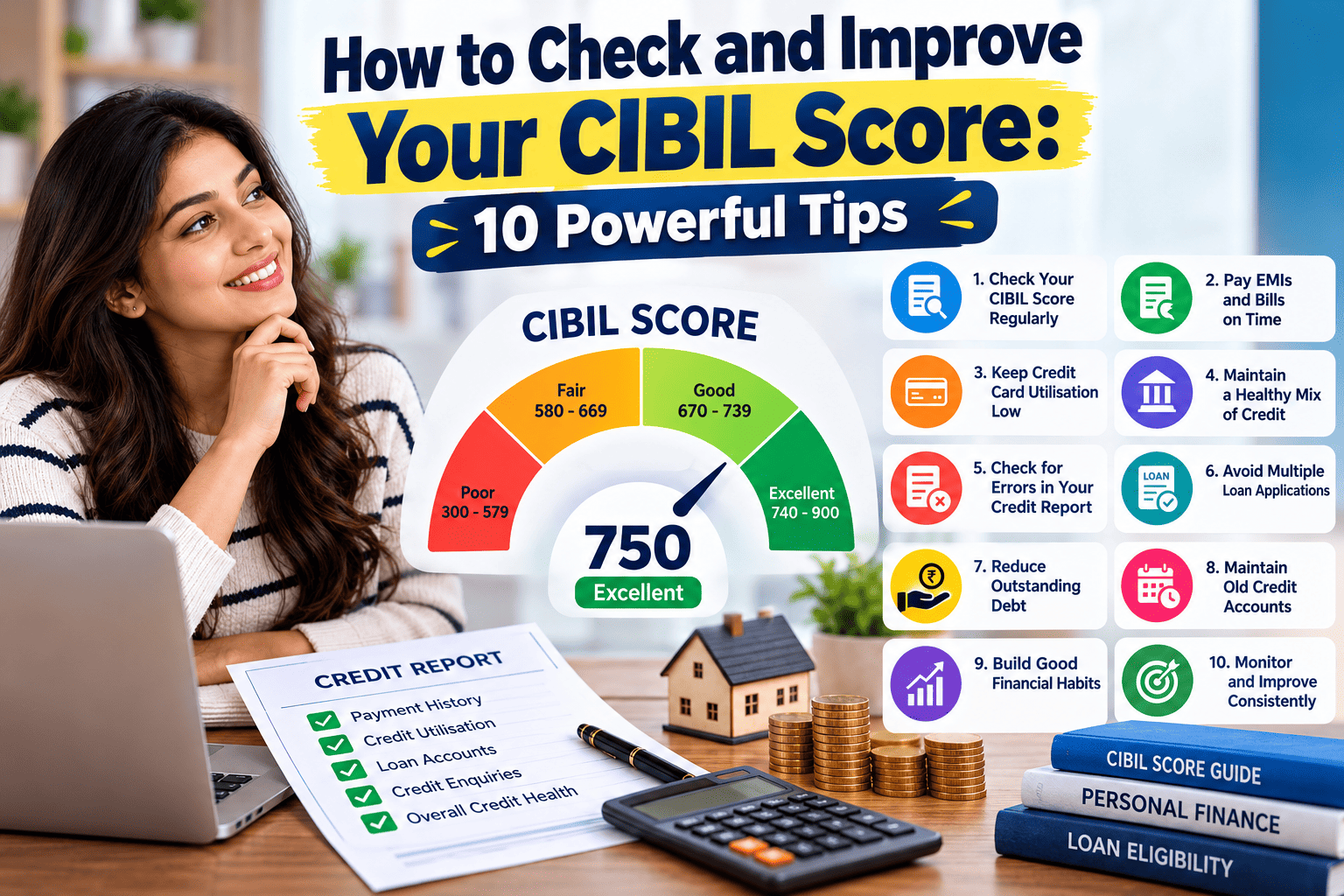
How to Check and Improve Your CIBIL Score: 10 Powerful Tips
Are you planning to apply for a home loan, personal loan, car loan, or credit card? Before applying, it is important to understand your credit history and check your CIBIL Score. A good credit profile can improve your chances of getting loan approval and may help you access better borrowing terms, depending on the lender’s policies.
If you want to learn how to check and improve your CIBIL Score, the first step is to obtain your credit report and review your repayment history, outstanding balances, and credit accounts. Even small habits, such as paying credit card bills on time and avoiding unnecessary loan applications, can help you maintain healthier credit over time.
In this guide, you will learn what a CIBIL Score means, how to check it online for free, what different score ranges indicate, and 10 practical ways to improve your credit profile in India.
If you want to understand how to check and improve your CIBIL Score, start with your credit report and identify the areas that need attention. Check your payment history, outstanding loan balances, credit card utilisation, and recent credit enquiries. Once you understand your current credit position, create a simple plan to pay bills on time and manage your existing debt responsibly.
What Is a CIBIL Score?
A CIBIL Score is a three-digit number that represents your credit history and credit behaviour. TransUnion CIBIL calculates this score using information in your credit report, including details about credit accounts and enquiries.
The score generally ranges from 300 to 900. A higher score generally indicates a stronger credit history, although lenders also consider your income, existing financial obligations, employment or business stability, and their own lending policies.
Your CIBIL Score may be considered when you apply for:
- Home loans
- Personal loans
- Car and two-wheeler loans
- Credit cards
- Other credit facilities
A strong score does not guarantee loan approval. Lenders assess your complete financial profile before making a decision.
Why Is Your CIBIL Score Important?
Your credit score can influence how lenders evaluate your application. Maintaining a healthy credit history may improve your borrowing options.
Here are some important reasons to monitor your score:
1. Better loan eligibility: A stronger credit profile may improve your chances of meeting a lender’s eligibility requirements.
2. Potentially better interest rates: Some lenders may offer more favourable rates to applicants with stronger credit profiles.
3. Easier financial planning: Checking your report helps you understand your existing loans, balances, and repayment history before applying for new credit.
4. Early detection of errors: You can identify incorrect account information, unfamiliar loan enquiries, or other discrepancies.
5. Better credit habits: Regular monitoring helps you see how repayment behaviour and credit usage affect your credit profile.
How to Check Your CIBIL Score Online for Free
You can check your CIBIL Score and report directly through the official TransUnion CIBIL website.
Follow these steps:
- Visit the official website: https://www.cibil.com/
- Open the Free CIBIL Score and Report section.
- Register for an account or log in if you already have one.
- Enter the requested personal details and complete the identity verification process.
- View your CIBIL Score and credit report.
- Review your account details, repayment history, and credit enquiries.
TransUnion CIBIL provides one free CIBIL Score and Report per calendar year. Additional access may require a paid plan, depending on the service selected.
Important: Use the official website and protect your PAN details, date of birth, passwords, and other personal information. Checking your own CIBIL Score does not reduce it.
Learning how to check and improve your CIBIL Score also means reviewing your credit report periodically. Look for incorrect personal details, unfamiliar loan accounts, duplicate entries, or payments incorrectly marked as overdue. If you find an error, contact the lender or raise a dispute with the credit bureau. Correcting genuine errors may help ensure that your credit report reflects accurate information.
CIBIL Score Ranges: What Does Your Score Mean?
Your score is one part of your overall credit profile. The following table is a general guide to understanding different score levels, not a guarantee of how a lender will assess your application.
| CIBIL Score Range | General Interpretation |
|---|---|
| 300–549 | Low score; review repayment history and credit report |
| 550–649 | Needs improvement; focus on timely payments and outstanding debt |
| 650–699 | Moderate score; continue building consistent credit habits |
| 700–749 | Generally a good score |
| 750–900 | Strong score that may be viewed favourably by lenders |
These ranges are indicative. Individual lenders may use different internal criteria, and approval also depends on income, debt obligations, loan type, and other factors.
A score below 700 does not automatically mean that your loan will be rejected. Similarly, a score above 750 does not guarantee approval.
How to Improve Your CIBIL Score: 10 Powerful Tips
1. Pay All EMIs and Credit Card Bills on Time
Payment history is an important part of your credit profile. Late payments, missed EMIs, and overdue credit card bills can negatively affect your score.
To develop a consistent repayment habit:
- Set reminders before every due date.
- Use standing instructions or auto-pay where appropriate.
- Keep sufficient funds available for scheduled payments.
- Contact your lender promptly if you are struggling to make a payment.
Do not rely entirely on reminders. Check your bank account and payment confirmations to make sure your payments have been completed successfully.
2. Keep Your Credit Card Utilisation Low
Credit utilisation refers to how much of your available credit limit you are using.
For example, if your credit card limit is ₹1,00,000 and your outstanding balance is ₹20,000, your utilisation is 20%.
A lower utilisation ratio is generally preferable. As a practical target, many consumers try to keep their utilisation below 30%, although this is not a universal approval rule or guaranteed score threshold.
You can manage utilisation by:
- Paying your balance regularly.
- Avoiding unnecessary purchases on credit.
- Requesting a higher limit only if it suits your financial situation.
- Keeping spending within a manageable budget.
A higher credit limit is not a reason to increase your spending.
3. Avoid Applying for Multiple Loans at Once
When you apply for credit, a lender may make a hard enquiry on your credit report. Several applications within a short period can create multiple enquiries and may affect how lenders view your credit profile.
Before applying for a loan or credit card:
- Check your eligibility.
- Compare lenders and their terms.
- Review interest rates, fees, and repayment obligations.
- Apply only when you are ready to proceed.
Checking your own score is different from a lender making a hard enquiry and does not lower your score.
4. Review Your Credit Report for Errors
Your credit report may contain incorrect information because of reporting mistakes, outdated account details, or other discrepancies.
Check the following carefully:
- Personal details and identification information
- Loan accounts you recognise
- Credit card balances and limits
- Payment history
- Account status
- Loan accounts shown as overdue or outstanding
- Credit enquiries you do not recognise
If you find an error, raise a dispute through the official CIBIL website and contact the relevant bank or financial institution where necessary.
Keep copies of your complaint, supporting documents, and reference numbers. Disputed information is subject to verification, so correction is not automatic.
If your credit report contains an incorrect overdue payment, an unfamiliar account, or a loan that does not belong to you, contact the relevant lender and raise a dispute. When learning how to check and improve your CIBIL Score, remember that accurate reporting matters. Keep copies of supporting documents and review the report again after the dispute has been resolved. A correction may help if the error was negatively affecting your credit profile.
5. Maintain a Healthy Credit History
Lenders generally want to see evidence that you can manage credit responsibly. Paying existing obligations on time and avoiding unnecessary debt can help establish a healthier credit history.
If you already have credit accounts, maintain consistent repayment behaviour. Avoid borrowing money merely to increase your score.
A longer, positive repayment history can be useful, but there is no need to take on a new loan solely for this purpose.
6. Do Not Close Old Credit Cards Without Considering the Impact
Closing a credit card can affect your available credit limit and the overall structure of your credit profile. The effect on your score depends on your circumstances and the information used by the scoring model.
Before closing an old card, consider:
- Whether you use the card regularly.
- Whether it has an annual fee.
- Whether closing it would significantly reduce your available credit.
- Whether you can manage the card safely without accumulating debt.
If a card is expensive or encourages unnecessary spending, closing it may still be the right financial decision. Your budget and financial discipline should come first.
7. Maintain a Manageable Credit Mix
Your credit profile may include secured loans, such as home loans and vehicle loans, and unsecured credit, such as personal loans and credit cards.
A varied credit profile can be one consideration in credit assessment, but you do not need to take out different types of loans just to improve your score.
Choose borrowing products based on genuine needs and your ability to repay them. Taking on unnecessary debt can create more financial pressure than benefit.
8. Avoid Unnecessary Loan Settlements
If you cannot repay a loan in full, your lender may offer a settlement arrangement. However, a settled account may be reported differently from an account that has been fully repaid and closed.
Before agreeing to a settlement, ask the lender how the account will be reported to credit bureaus and request written confirmation of the terms.
If you have already settled an account, check your credit report to ensure the details accurately reflect the agreement. If your circumstances allow, ask the lender whether any outstanding amount can be repaid and whether the reporting status can legitimately be updated.
Never assume that paying a settlement amount automatically removes the account from your credit history.
9. Keep Your Credit Accounts Secure
Fraudulent loan applications or unfamiliar credit enquiries can create problems for your financial profile.
To protect yourself:
- Never share OTPs, banking passwords, or PINs.
- Avoid suspicious loan offers promising guaranteed approval.
- Check your credit report for unfamiliar accounts.
- Contact the relevant lender immediately if you notice an account you did not open.
- Raise a dispute through the official credit bureau process.
If you suspect identity theft, act promptly and preserve all relevant records.
Your credit report helps you understand the factors affecting your score. When following a plan for how to check and improve your CIBIL Score, review your active loans, closed accounts, repayment records, and credit enquiries. If an account appears incorrectly or a payment is wrongly marked as overdue, contact the lender and raise a dispute. Checking your own credit score does not reduce it.
10. Be Patient and Monitor Your Progress
Improving your CIBIL Score takes time. Your score may not change immediately after you pay an overdue amount or reduce a credit card balance.
Creditors report account information to credit bureaus periodically, and the time needed for updates can vary.
A practical routine is to:
- Pay all dues on time.
- Review outstanding balances each month.
- Avoid unnecessary credit applications.
- Check your credit report for errors.
- Track your progress periodically.
There is no guaranteed number of days in which a score will improve. Your result depends on your existing credit history, the changes you make, and when lenders report updated information.
One of the most important steps in learning how to check and improve your CIBIL Score is developing consistent repayment habits. Pay your EMIs and credit card bills by their due dates, avoid unnecessary borrowing, and keep your credit card balances under control. Regular payments and responsible credit use can support a healthier credit profile over time. Remember that improvements are not guaranteed immediately, as your score depends on your overall credit history and the information reported by lenders.
A practical way to improve your credit profile is to use credit cards carefully and repay outstanding amounts on time. Avoid using most of your available credit limit, and apply for new loans only when necessary. When you understand how to check and improve your CIBIL Score, you can make better borrowing decisions and avoid habits that may negatively affect your credit profile.
Following a monthly plan can make it easier to understand how to check and improve your CIBIL Score. Review your credit card statements, check upcoming EMI dates, and make sure your bank account has enough funds for scheduled payments. Keep a record of outstanding balances and avoid taking on unnecessary debt. These small steps can help you manage your credit more responsibly over time.
How Long Does It Take to Improve a CIBIL Score?
The time required to improve your CIBIL Score depends on the reason for the low score and the condition of your existing credit history.
For example:
- Recent missed payments: Consistent repayment can help build a better record, but past late payments may remain visible.
- High credit utilisation: Reducing balances may help once updated information is reported.
- Incorrect report information: The timeline depends on the investigation and correction process.
- Limited credit history: Building a positive record generally requires responsible use over time.
- Serious defaults: Recovery may take longer and depends on the nature of the account and repayment history.
Avoid services that promise to increase your score by a fixed number of points within a few days. No legitimate provider can guarantee a particular score improvement.
Common Mistakes That Can Lower Your CIBIL Score
Even financially responsible people can make mistakes that affect their credit profiles.
Avoid these common problems:
Missing payment due dates: Late payments can harm your repayment history.
Using most of your credit limit: High utilisation may make your credit profile appear more stretched.
Applying for too much credit: Multiple hard enquiries can be a concern for lenders.
Ignoring your credit report: Errors or unfamiliar accounts may go unnoticed.
Borrowing to improve your score: Taking unnecessary loans increases financial obligations without guaranteeing a better score.
Trusting guaranteed score-improvement offers: Be cautious of anyone asking for payment to remove accurate negative information or promising guaranteed results.
The safest approach is to maintain disciplined repayment habits and use official channels to resolve genuine reporting errors.
Frequently Asked Questions (FAQs)
1. How can I check my CIBIL Score for free?
Visit the official TransUnion CIBIL website, register or log in, complete the requested verification, and access your free CIBIL Score and Report. CIBIL offers one free report per calendar year.
2. What is a good CIBIL Score in India?
A score above 700 is generally considered good, according to CIBIL’s consumer guidance. A score closer to 900 may be viewed more favourably, but every lender has its own eligibility criteria.
3. Does checking my own CIBIL Score reduce it?
No. Checking your own score is a self-check and does not lower it. A lender’s credit enquiry when you apply for credit is a different process.
4. How can I improve my CIBIL Score quickly?
Start by paying overdue amounts, making all future payments on time, reducing high credit card balances, and checking your report for errors. The effect and timeline depend on your individual credit history.
5. Can I improve my CIBIL Score without a credit card?
Yes. You do not need a credit card specifically to build a credit history. Responsible repayment of eligible existing loans can help establish a positive record. If you have no credit history, your score may be unavailable or not generated until sufficient information exists.
6. Does paying off a loan improve my CIBIL Score?
Paying off a loan responsibly can improve your overall financial position, but the score impact varies. The lender must report the correct account status, and updates may take time to appear.
7. How often should I check my CIBIL Score?
You can review your report periodically to monitor changes and identify errors. Your free CIBIL report is available once per calendar year; additional access may depend on the provider’s available plans.
8. Can a low CIBIL Score prevent me from getting a home loan?
A low score may reduce your chances of approval or affect the terms offered, but it does not automatically mean rejection. Lenders also assess income, repayment capacity, existing obligations, property details, and their own eligibility requirements.
Knowing how to check and improve your CIBIL Score is useful, but maintaining good financial habits is equally important. Set payment reminders, keep track of loan balances, review your credit report, and avoid unnecessary credit applications. Your score may take time to respond to positive changes, so stay consistent rather than expecting an immediate increase.
Understanding how to check and improve your CIBIL Score is not a one-time task. Review your credit profile periodically, continue paying EMIs and credit card bills on time, and keep your credit utilisation manageable. Avoid applying for several credit products in a short period. Consistent habits can support long-term credit health, although the time needed for a score to change varies from person to person.
Conclusion
Learning how to check and improve your CIBIL Score is an important step towards better financial management. Start by obtaining your credit report, reviewing every account, and identifying areas that need attention.
Pay your EMIs and credit card bills on time, keep outstanding balances manageable, avoid unnecessary loan applications, and correct genuine errors through official channels. These habits can help you build a stronger credit history over time.
Remember that a good CIBIL Score is not created overnight. Consistent financial discipline, careful borrowing, and regular monitoring are more useful than shortcuts or promises of instant improvement.
📖 Next Blog: Continue Reading on My Daily Viral
Want to keep exploring the latest trending topics, guides, and updates? Check out our other popular blogs below 👇
🎬 Entertainment & Movies
-
🇮🇳 Battle of Galwan Movie 2026: Salman Khan’s Powerful War Drama Based on Real Events
📱 Technology & Gadgets
-
📱 Amazing iPhone 17 Series (2025) – Full Review, Top Features & Price in India
-
☁️ What is Cloud Computing? Beginner’s Guide (AWS, Azure, GCP Explained)
👗 Fashion & Festivals
-
💃 Navratri Lehengas Chaniya Cholis 2025 – Stunning Trends, Colors & Styling Ideas
-
🎉 Explore 2025 Festival & Wedding Fashion in India – For Men, Women & Kids
-
🪔 Navratri 2025: 9 Days of Goddess, History, Rituals, Fashion & Fasting
🧘 Health & Lifestyle
-
🧘♀️ How to Include Yoga in Your Daily Routine | 10 Simple Ways for a Healthy Life
-
🌿 Yoga for Back Pain: Ultimate Guide to Relief, Flexibility & Strength
-
💪 Daily Home & Office Workout Routine Without Equipment – Stay Fit Anywhere
-
🥗 Ultimate Guide to Weight Loss in 2025-26: Diet, Workouts & Lifestyle Tips
-
🍛 7-Day Indian Weight Loss Diet Plan (Veg & Non-Veg) – 2025-26 Edition

